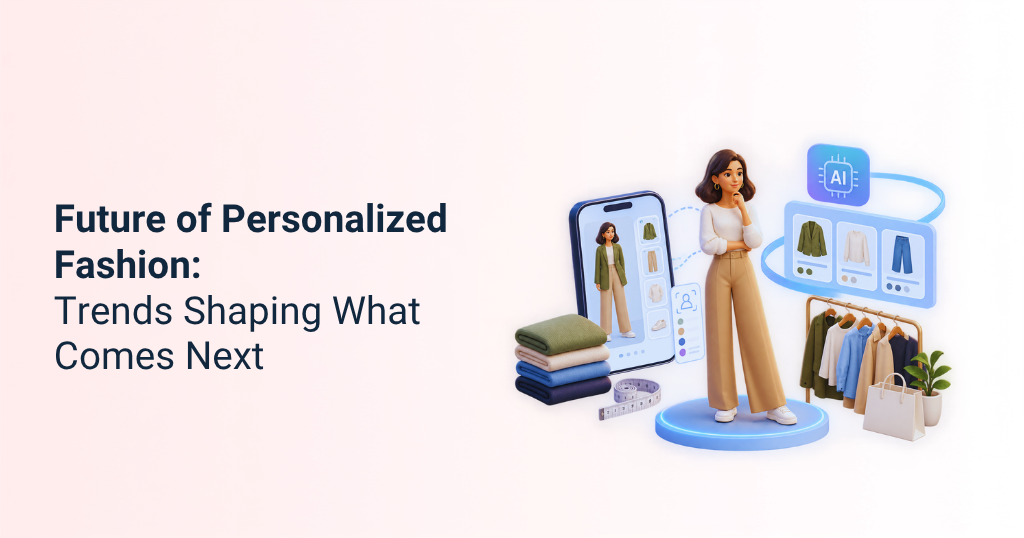
The future of personalized fashion will be shaped by how effectively brands connect individual preferences with commercially viable production. Customers increasingly expect clothing that reflects their style, preferred fit, and functional needs, while apparel businesses must manage costs, inventory, and manufacturing complexity.
Digital tools are making this balance more achievable by connecting online product experiences with design visualization, configurable products, and production workflows.
The most significant opportunities will emerge when personalization becomes part of the operating model rather than an isolated ecommerce feature. Understanding these developments can help businesses identify practical investments without committing to expensive technology before their needs are clear.
The future of personalized fashion combines AI, digital customization, virtual product development, body-based fit personalization, and on-demand production to help brands deliver more individualized products while maintaining operational efficiency.
Key Takeaways
- The future of personalized fashion depends on combining customer choice with production capabilities, rather than simply expanding product options.
- AI, 3D visualization, and configurable product interfaces can help brands offer relevant customization with greater operational control.
- On-demand manufacturing and digital sampling can support more responsive production, although results depend on implementation and supplier readiness.
- Businesses should prioritize technologies that integrate with existing commerce, design, and manufacturing systems and deliver measurable improvements.
What Is the Future of Personalized Fashion?
The future of personalized fashion is moving toward a model in which customers can influence a garment’s appearance, fit, materials, and functional details while brands retain control over production. Instead of manufacturing identical products for everyone, businesses can offer defined choices through digital interfaces and fulfill orders using standardized processes.
Personalization exists on a spectrum:
- Visual customization: Customers change colors, patterns, graphics, or text.
- Style configuration: Buyers select design elements such as collars, sleeves, pockets, or trims.
- Fit personalization: Garments are adapted to individual measurements or fit preferences.
- Made-to-order production: Manufacturing begins after a customer order is confirmed.
These approaches serve different business needs. A promotional apparel supplier may benefit from logo placement and print customization, whereas a premium clothing brand may need measurement-based tailoring.
It is worth highlighting that mass customization in fashion is becoming easier to manage when customer choices, product rules, and manufacturing requirements are connected digitally.
Why Are Consumers Demanding More Personalized Products?
Consumers are increasingly seeking products that align with their preferences and lifestyles, making personalization a key driver of modern purchasing decisions.
- A stronger desire for individuality: Modern consumers increasingly view fashion as a form of self-expression and prefer products that reflect their personal style, values, and identity rather than mass-produced designs.
- Higher expectations around fit and comfort: Shoppers are looking for apparel that aligns with their specific measurements, preferences, and lifestyle needs, making personalized options more appealing than standard sizing.
- The rise of digital shopping experiences: Online platforms now offer tailored recommendations, virtual styling tools, and customization features, encouraging consumers to expect more relevant and individualized product choices.
- Changing preferences among younger buyers: Gen Z and Millennial consumers often value uniqueness, authenticity, and exclusivity, making them more likely to engage with brands that offer personalized fashion experiences and products.
6 Personalized Fashion Trends That Will Shape the Industry
Several personalized fashion trends are gaining relevance because they address practical challenges in product development, ecommerce, and manufacturing. Their value depends on how well they fit a brand’s customer base and operational capabilities.
1. AI-Powered Design and Recommendations
AI in personalized fashion can help customers discover relevant products, explore design variations, and receive recommendations based on their preferences. Design teams can also use generative tools to explore concepts before committing resources to physical development.
For example, a customer shopping for a corporate uniform could receive recommendations based on preferred colors, garment types, and branding requirements. A business buyer could configure a design that meets company guidelines instead of starting from a blank canvas.
However, AI-generated concepts still require checks for fabric availability, construction feasibility, intellectual property, and brand consistency. Human designers remain important for translating attractive concepts into commercially viable products.
2. Interactive Product Customization
Interactive configurators let customers modify selected product attributes and preview the result before ordering. This makes fashion product customization more tangible than choosing options from a text-only dropdown menu.
A sportswear brand, for instance, could let buyers choose jersey colors, add player names, upload team logos, and preview the completed design. The business can define which combinations are permitted, reducing invalid orders and manual clarification.
Platforms offering product customization software can support these experiences by connecting product options with visual previews and order information. The next step for brands is to ensure that those choices translate into accurate production instructions.
3. Virtual Sampling and 3D Visualization
Digital garment visualization allows teams to evaluate designs before producing physical samples. Designers can examine colors, proportions, and certain fabric behaviors on a digital model, making revisions easier to review and share.
This development is especially relevant for brands managing multiple product variants, distributed design teams, or frequent buyer approvals.
Explore how virtual sampling can support digital product reviews. For a deeper look at the operational implications, read virtual sampling in fashion to reduce cost & waste.
Digital sampling does not eliminate every physical prototype. Fabric hand feel, specialized construction, durability, and production quality may still require physical validation. Its greatest value comes from reducing unnecessary sampling rounds while preserving essential quality checks.
4. Made-to-Order and Small-Batch Production
Made-to-order models allow businesses to produce garments after receiving confirmed demand. Smaller production runs also give brands greater flexibility to test designs, serve niche audiences, and introduce limited editions.
For example, an apparel company could offer a core collection with optional embellishments, then produce customized variations after purchase. This can reduce dependence on forecasting demand for every possible combination.
However, small batches are not automatically cheaper. Frequent changeovers, material minimums, labor requirements, and delivery commitments can increase unit costs. Businesses need production partners and workflows that can accommodate variation without undermining margins.
5. Connected Digital Commerce and Manufacturing
Fashion industry operations increasingly depend on connecting customer-facing experiences with back-office systems.
A product configurator may capture a customer’s selections, but those selections must also reach order management, inventory, pricing, and manufacturing teams accurately. Otherwise, personalization creates more manual work rather than reducing it.
This is where custom clothing technology can become part of a broader digital workflow. APIs, structured product data, and automated order handoffs can help reduce duplicate entry and discrepancies between what a customer sees and what a factory receives.
6. Personalization Across Business Channels
Personalization will extend beyond direct-to-consumer fashion stores. B2B uniform suppliers, promotional merchandise businesses, private-label manufacturers, and print service providers can also offer tailored product experiences.
For example, a corporate buyer might configure branded apparel for several departments while maintaining approved colors, logos, and budget limits. A reseller could customize products for individual clients without requiring the manufacturer to create a completely new product for every order.
Solutions such as web to print solutions are relevant when apparel customization includes artwork placement, logos, text, and print-ready output.
As personalization initiatives become more complex, brands need technologies that connect customer experience with production workflows.

What Is Holding Back Personalized Fashion Today?
The biggest obstacle is not a lack of design ideas. It is the difficulty of delivering individual choices consistently without creating excessive operational complexity.
Three constraints deserve particular attention.
- Fragmented workflows: Design files, product options, pricing rules, and production instructions may sit in separate systems. Every manual handoff creates another opportunity for errors.
- Uncertain unit economics: Custom orders may require additional setup, specialized labor, or smaller material purchases. A higher selling price does not guarantee a higher profit margin.
- Inconsistent customer expectations: A digital preview can create confidence, but inaccurate sizing information or unrealistic material rendering can lead to disappointment.
The broader fashion digital transformation therefore requires more than adopting a new customer interface. Businesses need to examine how design decisions, product data, order processing, and fulfillment work together.
For further context on the economics of this transition, read how digital fashion reduces manufacturing cost .
Is Mass Customization Becoming the New Fashion Model?
Mass customization is reshaping fashion by blending large-scale production with individual preferences. While it offers exciting opportunities for brands and shoppers alike, its practicality depends on production capabilities, technology, and consumer demand. Understanding both its strengths and constraints helps explain where this model is gaining the most momentum today.
- Benefits: Delivers better-fit products, greater customer satisfaction, and a stronger sense of individuality while helping brands increase engagement and loyalty.
- Challenges: Requires advanced manufacturing systems, accurate customer data collection, and efficient supply chain coordination to fulfill unique orders at scale.
- Limitations: Higher production costs, longer delivery timelines, and difficulties maintaining consistency can restrict widespread adoption in some market segments.
- Where It Works Best: Most effective in categories such as footwear, sportswear, made-to-measure apparel, accessories, and premium fashion where personalization adds clear value for customers.
What Will Personalized Fashion Look Like in the Next 5 Years?
Personalized fashion is expected to move beyond simple product recommendations and become deeply embedded across the entire fashion value chain. Over the next five years, advances in data, automation, and digital technologies will enable brands to create products that better reflect individual preferences, fit requirements, and purchasing behavior.
- AI-Assisted Product Creation: Designers will increasingly use AI tools to analyze trends, consumer preferences, and purchasing patterns, helping them develop personalized collections faster while reducing design guesswork and accelerating product innovation.
- Hyper-Personalized Recommendations: Recommendation engines will become more sophisticated, using browsing habits, style preferences, purchase history, and contextual data to deliver highly relevant product suggestions tailored to each shopper.
- Body-Scanning and Fit Personalization: Advanced body-scanning technologies will make size-related inaccuracies less common, enabling brands to offer garments customized to individual body measurements for greater comfort and confidence.
- On-Demand Production: Instead of producing large inventory volumes, brands may manufacture products only after orders are placed, helping reduce waste while supporting greater levels of customization.
- Digital Twins: Consumers could create digital replicas of themselves to virtually test clothing, experiment with styles, and evaluate fit before purchasing, improving the online shopping experience.
- Integrated Design-to-Manufacturing Workflows: Connected digital systems will streamline the journey from product design to production, allowing brands to efficiently translate customer preferences into personalized products at scale.
How Can Businesses Prepare for the Future of Personalized Fashion?
Businesses can prepare by starting with one commercially meaningful personalization use case, validating its operational feasibility, and expanding only after measuring results.
A practical approach involves four steps.
Step 1: Identify Where Personalization Adds Value
Review customer requests, lost sales, product returns, and manual design work. Determine whether the strongest opportunity lies in visual customization, better fit, made-to-order production, or B2B product configuration.
Step 2: Define the Permitted Choices
List the attributes customers can change and the rules that govern them. Specify compatible materials, available sizes, print areas, price adjustments, and production limitations before building the experience.
Step 3: Connect the Customer Experience to Fulfillment
Ensure that confirmed selections reach the relevant operational systems. The objective is to make the approved design and its specifications usable downstream, not simply display an attractive preview.
Step 4: Test Results Against a Baseline
Measure conversion, average order value, order-processing time, customization errors, returns, and contribution margin. Compare pilot results with a similar product or an earlier period, accounting for differences in demand and product mix.
These steps make the future of personalized fashion a measurable business initiative rather than an open-ended technology experiment.
Which Technologies Should Fashion Businesses Compare?
The right technology depends on what the business is trying to personalize. Different tools address different stages of the customer and production journey.
| Technology | Primary purpose | Best suited for | Key consideration |
| AI design and recommendations | Generate concepts or suggest relevant products | Design teams and digital retailers | Human review and data quality |
| Product configurators | Let customers select and preview product variations | Apparel brands and B2B sellers | Product rules and integration |
| 3D design and virtual sampling | Review garments digitally before production | Designers and manufacturers | Simulation accuracy and physical validation |
| Made-to-order systems | Coordinate production around confirmed demand | Niche brands and custom apparel businesses | Capacity, lead times, and unit economics |
| Web-to-print platforms | Manage artwork, personalization, and print workflows | Promotional apparel and print businesses | Output accuracy and production compatibility |
For technology leaders, the comparison should extend beyond feature lists. Evaluate compatibility with existing ecommerce platforms, design tools, order management, and manufacturing processes. Also consider security, scalability, implementation effort, and the ability to support future product categories.
The fashion industry digital transformation of a business is more likely to succeed when new capabilities fit into its existing operating model instead of creating another disconnected workflow.
| Technologies Driving Personalized Fashion | |
|
|
Where Does iDesigniBuy Fit into This Shift?
For businesses exploring digital customization, iDesigniBuy offers technology options that support interactive product experiences and digital workflows. The appropriate solution depends on whether the primary requirement is customer-led product design, print customization, or digital sampling. Important capabilities include product configurators, digital customization, visual personalization, web-to-print workflows, and manufacturing-ready order output.
A useful evaluation begins with a representative product and a real workflow. Ask how a customer makes selections, how the resulting design is validated, and how the approved order information moves to fulfillment. This reveals more about practical suitability than a generic feature presentation.
If you are exploring the future of personalized fashion for your business, review iDesigniBuy’s product customization platform and assess its capabilities against your requirements.

Conclusion
The long-term opportunity lies in making personalization commercially repeatable. Businesses that understand which choices customers value, how those choices affect production, and where digital systems can remove friction will be better positioned to develop differentiated apparel offerings.
Rather than investing in every emerging technology, decision-makers should prioritize capabilities that solve a defined business problem and can grow with changing demand. The future of personalized fashion will not look identical for every company: a print provider, a premium label, and a large apparel manufacturer will need different combinations of tools.
For teams considering their next steps in fashion configuration and customization, a focused platform demonstration can help clarify workflow requirements, integration needs, and implementation priorities before a larger commitment. Schedule a demo to experience it firsthand.
Frequently Asked Questions
1. What is personalized fashion?
Personalized fashion allows customers to influence clothing through choices such as colors, graphics, materials, sizing, or design details. Depending on the business model, these choices may be fulfilled through configurable products, made-to-order manufacturing, or bespoke tailoring.
2. Why is the future of personalized fashion important for apparel businesses?
The future of personalized fashion matters because brands can explore new customer experiences and differentiated product offerings. Success depends on balancing customer choice with production feasibility, delivery expectations, and the cost of fulfilling individual orders.
3. How does AI support personalized fashion?
AI can assist with design ideation, product recommendations, trend analysis, and customer preference discovery. Its suggestions still require human review to verify design originality, garment feasibility, brand suitability, and compatibility with available materials and manufacturing processes.
4. What is mass customization in the fashion industry?
Mass customization in the fashion industry combines standardized production processes with selected individual choices. Customers personalize approved product attributes, while businesses use predefined rules and repeatable workflows to manage variation more efficiently than fully bespoke production may allow.
5. Can digital customization reduce fashion waste?
Digital customization may help reduce unnecessary physical samples and support production based on confirmed orders. However, environmental benefits depend on material sourcing, manufacturing efficiency, shipping, product durability, and actual changes in overproduction rather than technology adoption alone.
6. How should a business choose personalized clothing design software?
Evaluate personalized clothing design software against your product types, customer experience requirements, production workflow, integration needs, and budget. Test a representative order, inspect the resulting production data, and compare measurable outcomes before committing to a broader rollout.