A clothing designer is no longer simply a digital canvas for changing colors or adding text to a garment. For apparel businesses, it can become a commercial layer between product discovery, customization, ordering, and fulfillment. That distinction matters when evaluating technology for an existing ecommerce operation.
The designer can let customers choose fabrics, colors, patterns, measurements, logos, text, and other approved attributes while seeing the result before purchase. For the business, the value depends on what happens behind that interface: whether selections are structured, pricing is controlled, orders carry the right configuration data, and the system can scale across products and markets.
This clothing designer tool guide explains what the technology does, where the business case comes from, how to evaluate vendors, and what should be checked before purchase. It is intended for technology and apparel leaders assessing digital customization as a serious business capability rather than a visual add-on.
NOTE: In this guide, “clothing designer” refers to an online apparel customization and product-configurator tool, not fashion CAD software used primarily for garment pattern development or technical design.
Key Takeaways
- A clothing designer is most valuable when it connects customer-facing customization with product, order, and production workflows.
- The suitable online clothing designer balances creative freedom with rules that protect margins, manufacturability, and brand consistency.
- ROI should be measured through conversion, average order value, operational time, sampling effort, and order accuracy.
- Enterprise buyers should evaluate integrations, rendering performance, scalability, localization, data ownership, and vendor support.
What Is a Clothing Designer and How Does It Work?
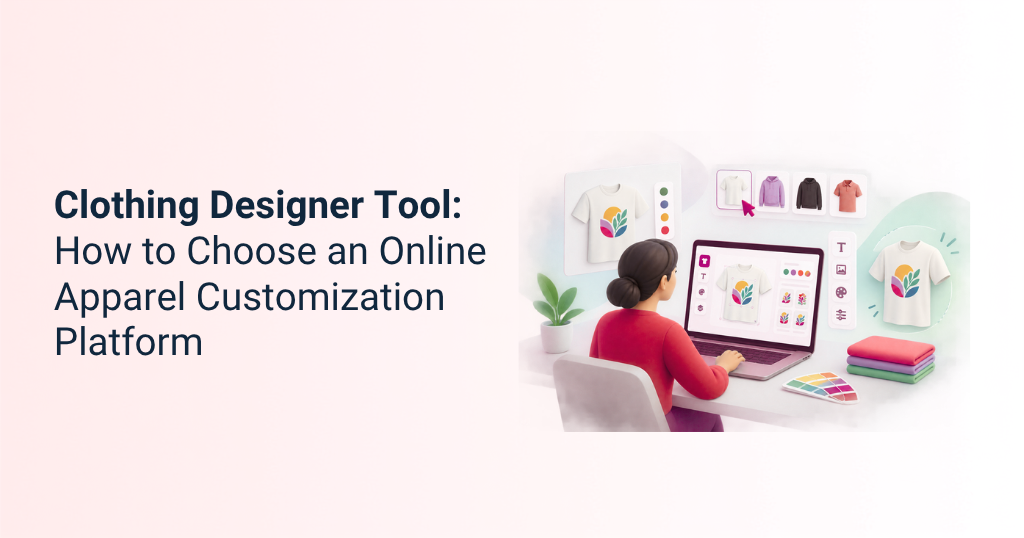
A clothing designer is software that allows a customer, designer, or sales team to configure an apparel product digitally and preview the resulting design before it is ordered. Depending on the implementation, it can support ready-made products, made-to-measure garments, teamwear, uniforms, promotional apparel, or bespoke fashion.
5 Connected Layers of a Typical Clothing Design Workflow
- Product setup: The business defines garments, components, fabrics, colors, patterns, decoration areas, sizes, measurements, and allowed combinations.
- Customer configuration: The shopper changes approved attributes through a browser-based interface rather than relying on back-and-forth communication.
- Visual rendering: The interface updates product views as selections change. Multi-angle or 3D visualization can provide additional context for complex garments. Note that 3D adds rendering complexity and asset-production requirements, so buyers should justify it based on garment complexity, customer needs, and expected commercial value.
- Commercial logic: Options can be associated with prices, rules, quantities, or other order conditions.
- Order handoff: The final configuration can move into ecommerce, customer management, order management, production, or fulfilment workflows.
| Layer | What it does | What buyers should validate |
| Product setup | Defines garments/options | Catalog/rule management |
| Configuration | Customer selects options | UX and conditional logic |
| Rendering | Shows design | Accuracy/performance |
| Commercial logic | Pricing/rules | Dynamic pricing/constraints |
| Order handoff | Sends configuration downstream | Ecommerce/ERP/production integration |
The important distinction is between a design interface and a connected customization system. A solution that produces an attractive preview but leaves staff to manually interpret the order may create another operational step instead of removing one.
For apparel businesses, this is why an apparel design software should be assessed against the full workflow. iDesigniBuy‘s solution includes capabilities such as fabric and color selection, pattern modification, logo or image upload, text personalization, multiple product views, real-time preview, customer profiles, and order-management integration.
Specialist implementations can address narrower use cases. For instance, a polo t-shirt designer tool can support color, fabric, sizing, logos, initials, numbers, and preview functions, while tailoring-focused technology can address measurements, garment configuration, and made-to-measure requirements.
Why Should Businesses Invest in a Clothing Designer?
The business case for an apparel designer comes from reducing friction between customization demand and operational execution. The strongest use cases connect customer choice to measurable commercial or workflow outcomes.
1. Turn customization into a structured buying journey
Traditional customization often depends on forms, emails, sales calls, spreadsheets, or manual artwork approval. A digital interface moves those decisions into a defined sequence. Customers can see what they are selecting, while the business controls which options are actually available.
Instead of asking a customer to describe a navy jacket with a particular lapel, lining, button, and monogram, the system can capture each choice as structured product data. You can get a demo of the jacket design tool to understand its working better.
2. Support higher-value products and orders
Customization can change the commercial conversation from “Which variant do you want?” to “How should this product be built for you?” This is particularly relevant to bespoke apparel, uniforms, teamwear, premium shirts, custom suits, and made-to-measure products.
Higher AOV should still be treated as a measurable hypothesis rather than an automatic outcome. Compare customized and standard-product cohorts while accounting for discounts, production costs, returns, and acquisition costs.
3. Reduce manual design and communication work
A digital clothing designer can capture specifications at the point of selection instead of requiring staff to reconstruct them later. This can reduce repetitive clarification, artwork interpretation, and order-entry work.
For example, a teamwear provider receiving 200 customized polo shirts could collect names, numbers, sizes, colors, and logo placements through one workflow. The operational gain comes from structured information, not simply from allowing users to change the shirt visually.
4. Improve confidence before purchase
Visual feedback helps customers understand the relationship between their selections. This is especially useful when color placement, fabric, graphics, or fit choices materially change the final garment.
Businesses exploring this further can combine customization with virtual fit visualization. Our guide to Virtual Try-on Technology in Fashion Ecommerce explains how interactive visualization can address sizing uncertainty and create a more data-driven apparel shopping experience.
5. Create a foundation for digital apparel operations
An online clothing designer can generate structured preference and configuration data. Over time, that information can support merchandising decisions, product planning, customer profiles, production workflows, and personalization, provided the business has appropriate data architecture and governance.
Statista estimates that the worldwide fashion market is projected to reach US$957.31 billion in 2026. These figures describe digital fashion commerce overall, not the market for customization software specifically.
For technology buyers, the implication is straightforward: customization should be evaluated as part of an established digital commerce environment rather than as an isolated design feature.

Should You Build or Buy a Clothing Designer?
The build-versus-buy decision depends on how much customization your business needs, how quickly you need to launch, and whether your internal team can maintain the technology after implementation. For most apparel businesses, the comparison should include more than the initial development cost.
Building a clothing designer internally can provide complete control over the user experience, product logic, integrations, and roadmap. However, the business also assumes responsibility for rendering technology, configuration rules, asset management, browser and device compatibility, security, infrastructure, testing, and ongoing enhancements.
A specialized solution can reduce that development burden, but buyers should still verify how easily it can adapt to their existing technology stack.
| Consideration | Build internally | Buy specialized software |
| Initial control | High | Depends on vendor architecture |
| Time to launch | Usually longer | Potentially shorter |
| Custom functionality | Fully controlled | Depends on platform capabilities |
| Ecommerce integration | Internal responsibility | Vendor/platform dependent |
| Rendering and visualization | Must be developed or licensed | Usually available as part of solution |
| Product-rule management | Must be designed | Usually configurable |
| Maintenance | Internal team owns it | Shared with vendor |
| Scalability | Internal responsibility | Should be validated during evaluation |
| Long-term customization | High control | Subject to platform architecture |
| Technology risk | Primarily internal | Shared with vendor |
The decision should therefore be based on total ownership responsibility, not simply development cost.
For example, an apparel business with a highly specialized product and a large engineering team may have a reason to build certain components internally. A business that wants to introduce customization across an existing ecommerce operation may place greater value on a configurable platform that already addresses visualization, product rules, customer interaction, and integrations.
Questions to Ask to Decide on Build vs. Buy
- How quickly can the first production-ready experience launch?
- How much internal engineering capacity will it require?
- Who will maintain the product rules and visual assets?
- How easily can it integrate with existing commerce and operational systems?
- What happens when the business adds new products, markets, or customization options?
- Can the business export configurations?
- Can product data be migrated?
- Who owns customer-created designs?
- Can assets be exported?
- What happens if the vendor is replaced?
- Are APIs documented?
- Are historical configurations accessible?
Depending on the business model, make sure to ask whether the system can generate or pass:
- print-ready files
- embroidery files
- decoration specifications
- measurement data
- BOM/configuration information
- production instructions
- configuration IDs
- artwork placement information
The answers should account for the next three to five years, not only the first release.
What Does Implementing a Clothing Designer Actually Involve?
Implementing a clothing designer is primarily a product-data and workflow exercise, not just a front-end development project. The complexity usually increases with the number of configurable products, combinations, business rules, integrations, and downstream production requirements.
Before selecting a vendor, map the implementation into distinct workstreams.
Product and customization setup
First, determine exactly what customers can change. This can include:
- colors and fabrics
- patterns and prints
- collars, cuffs, buttons, and other components
- logos, images, names, and numbers
- measurements and sizing
- embroidery or printing positions
- personalization rules
- compatible and incompatible combinations
The more complex the product model, the more important the underlying configuration architecture becomes.
Visual asset preparation
Every customer-facing option needs an appropriate digital representation. Depending on the solution, this may involve product images, layered artwork, multiple views, textures, patterns, or 3D assets.
This is an often-overlooked implementation cost. A platform may support sophisticated visualization, but the business still needs accurate digital assets for its catalog.
Integration and data mapping
The clothing designer must exchange information with the systems that already run the business.
A typical flow may look like:
| Customer configuration |
| ↓ |
| Product/cart |
| ↓ |
| Checkout |
| ↓ |
| Order management |
| ↓ |
| ERP/production |
| ↓ |
| Fulfillment |
The implementation team should define exactly what information moves between each stage.
For example, an order may need to carry the selected fabric, color code, garment size, personalization text, uploaded artwork, measurements, configuration ID, and final price.
Business rules and automation
Rules determine what customers can actually configure. They can prevent invalid combinations, control pricing, restrict certain options by product, or trigger different workflows.
This is where a basic design interface differs from an operational customization system. The latter should reduce the need for employees to manually interpret customer selections.
Testing and rollout
Before going live, test the experience across the complete customer and operational journey.
10 Steps to a Practical Implementation Test
- Configure a real garment.
- Add personalization.
- Change the configuration before checkout.
- Complete the order.
- Verify the configuration data received downstream.
- Confirm pricing and inventory behavior.
- Test mobile and desktop experiences.
- Test invalid or incompatible combinations.
- Verify how customer-uploaded assets are handled.
- Measure the number of manual interventions required.
This approach exposes integration and workflow problems that a front-end product demonstration may not reveal.
Estimate total cost of ownership
The purchase price is only one part of the financial picture. Compare:
TCO = software + implementation + integration + asset creation + infrastructure + maintenance + internal administration + future customization
Ask vendors which components are included in the quoted price, and which are charged separately.
A solution with a lower initial price can become more expensive if every new product, integration, visual asset, or rule requires substantial engineering work. Conversely, a higher initial investment can make sense if it substantially reduces recurring operational or development costs.
Building the Business Case for a Clothing Designer
The business case for a clothing designer should combine revenue impact, operational savings, and risk reduction rather than relying on a single metric such as conversion rate.
Start with a baseline before implementation. Record how the current customization process performs and then estimate which parts of that process the software can change.
| Business area | Baseline to measure | Potential impact to test |
| Conversion | Standard-product vs. customized-product conversion | More completed customized orders |
| Average order value | Current AOV | Higher-value personalized purchases |
| Order processing | Minutes per customized order | Less manual processing |
| Clarifications | Emails/calls per order | Fewer specification questions |
| Rework | Orders requiring correction | Better configuration accuracy |
| Sampling | Cost and time per design | Reduced manual sampling |
| Customer service | Customization-related queries | Lower support workload |
| Repeat purchases | Customized customer reorder rate | Easier repeat customization |
For example, suppose a business processes 1,000 customized orders each month and spends an average of 12 minutes manually checking each configuration. That represents approximately 200 staff hours per month before accounting for clarification emails, corrections, and production handoffs.
If a digital workflow reduces that manual effort, the resulting labor saving can be quantified. The same approach can be applied to sampling, order corrections, customer service, or design administration.
Revenue impact should be treated separately. If customization increases AOV or conversion, calculate the incremental gross profit rather than simply counting additional revenue.
A practical model is:
Annual benefit = incremental gross profit + operational savings + avoided costs
Then:
Net annual benefit = annual benefit − recurring technology costs
And:
Payback period = implementation investment ÷ monthly net benefit
The numbers should come from your own business wherever possible. Vendor-provided benchmarks can help establish hypotheses, but they should not replace internal baseline data.
For a first-stage business case, use three scenarios:
- Conservative: limited adoption and modest operational improvement.
- Expected: realistic adoption based on current customer behavior.
- Upside: stronger adoption and broader use across the product catalog.
This gives technology and finance teams a more useful view than a single projected ROI percentage.
The business case should also account for strategic value that may not appear immediately in revenue. A structured customization workflow can create reusable product data, support new personalization services, make repeat orders easier, and provide a foundation for expanding digital apparel offerings.
Before approving the investment, connect the expected benefits to measurable KPIs and establish who will own those metrics after launch.
8 Criteria to Evaluate an Online Clothing Designer
1. Customization depth
Start with the product, not the feature list. Can the system represent the actual decisions customers need to make?
Check support for:
- fabrics, colors, prints, trims, and finishes
- measurements and sizing
- text, logos, images, embroidery, and graphics
- component-level customization
- conditional and incompatible options
- saved designs and repeat orders
A basic clothing designer tool may work for color and text personalization. A more complex apparel business may need configurable patterns, measurements, garment parts, and production rules.
2. Visual fidelity and performance
Ask how quickly the interface updates after a selection and whether the preview remains accurate across devices. Check image quality, multiple views, zoom, 3D capability where relevant, and behavior on mobile connections.
Performance matters because sophisticated rendering is not useful if customers abandon the experience while waiting for previews.
3. Integration architecture
For an existing ecommerce operation, integration can matter more than the visual interface.
Assess compatibility with:
- ecommerce platforms;
- product and catalog systems;
- ERP and order-management software;
- CRM and customer accounts;
- payment and pricing systems;
- production or print workflows;
- analytics and marketing platforms.
Ask whether integrations are API-based, middleware-dependent, or custom-built. Gain clarity on webhooks/events, authentication, data ownership, master-data ownership, synchronization frequency, retry/error handling, order-state synchronization, inventory synchronization, pricing synchronization, versioning, and monitoring.
Clarify what data moves in each direction and how failed transactions are handled. What happens when the configuration succeeds, but the order fails to reach the ERP? That exposes real architecture quality.
4. Automation and order accuracy
A clothing designer should reduce manual interpretation, not move it to another department. Ask whether the final configuration is stored as structured data and passed with the order.
If a customer selects a fabric, collar, cuff, monogram, and measurement set, production teams should not have to infer those decisions from a screenshot.
5. Scalability and governance
Evaluate how the system behaves when the catalog grows from 20 configurable products to hundreds or thousands. Ask how options are managed, who can change rules, how assets are versioned, and whether permissions exist for different teams.
Multi-store, multilingual, multi-currency, and regional catalog requirements should also be considered before implementation rather than added later.
6. Mobile and customer experience
An online clothing designer should work naturally on the devices your customers actually use. Check touch interactions, loading behavior, image handling, accessibility basics (e.g. keyboard navigation, screen-reader compatibility, text alternatives, contrast, touch targets, error messaging, etc.), and the number of steps required to reach checkout.
Test the experience with people unfamiliar with the system. A feature-rich interface can still underperform if users cannot understand what to do next.
7. ROI and total cost of ownership
Build the business case around measurable changes. A practical ROI model can include:
Annual benefit = Incremental gross profit + operational savings + avoided costs
Net annual benefit = Annual benefit − recurring technology costs
ROI = Net annual benefit ÷ total investment × 100
Payback period = Initial implementation investment ÷ monthly net benefit
Track baseline and post-launch measures such as:
- customization completion rate
- conversion rate
- average order value
- time spent processing customized orders
- order clarification volume
- design or sampling costs
- rework caused by specification errors
- repeat purchase rate
Do not count every increase in engagement as financial ROI. Tie each metric to a business process or revenue outcome.
8. Vendor implementation and support
Ask what happens after the contract is signed. Review implementation responsibilities, configuration support, documentation, training, testing, SLAs, upgrades, security practices, data ownership, and exit provisions.
For an enterprise apparel operation, vendor responsiveness can affect the practical cost of ownership as much as the initial license or development quote.
| Evaluation area | Basic requirement | Enterprise consideration |
| Customization | Colors, text, images | Rules, measurements, components, production logic |
| Visualization | 2D preview | Multi-angle or 3D rendering where justified |
| Integration | Ecommerce connection | API architecture across commerce, ERP, CRM, OMS |
| Order data | Configuration attached to order | Structured data mapped to downstream workflows |
| Scale | Small catalog | Large catalogs, stores, regions, traffic peaks |
| Localization | One market | Multiple languages, currencies, catalogs |
| Analytics | Usage tracking | Funnel, AOV, operational and ROI reporting |
| Support | Basic assistance | Implementation, SLA, training, optimization |
For buyers comparing online fashion design software, this distinction helps separate an attractive interface from the capabilities needed for production-scale operations.
Which Clothing Designer Model Fits Your Business?
The purchase decision should follow the business model. Not every apparel company needs the same level of customization.
Standardized apparel with light personalization: Choose a solution focused on colors, text, logos, images, and simple previews. The priority is speed and ease of use.
Teamwear, uniforms, and promotional clothing: Look for bulk customization, names and numbers, reusable designs, product rules, and order-level data. A dedicated polo customization solution can be relevant when this category is central to your offering.
Bespoke and made-to-measure apparel: Prioritize measurement capture, sizing logic, fabric libraries, pattern workflows, customer profiles, and production handoff. Dedicated tailoring software may be more appropriate than a generic configurator.
Multi-brand or enterprise apparel operations: Look for scalable catalog management, APIs, localization, permissions, analytics, and integration with existing business systems. The designer should fit into the architecture rather than become a disconnected microsite.
Before purchasing, run a proof of concept using one real product. Include its actual fabrics, rules, price logic, customer journey, and order handoff. Test the complete flow from configuration through downstream processing.
10 Questions to Ask Before Buying a Clothing Designer
The final shortlist should be based on evidence from your own workflow. Ask each vendor to demonstrate the same scenario rather than presenting unrelated feature tours. Request answers to these questions:
- Can we configure our most complex garment without custom development for every new option?
- How are product rules and incompatible combinations managed?
- Can configuration data flow into our existing ecommerce and order systems?
- What happens when a customer changes an order after submission?
- How are 2D, multi-view, or 3D assets created and maintained?
- Can internal teams manage products without developer involvement?
- What happens to performance during traffic spikes?
- How are customer data, designs, assets, and configurations stored?
- What implementation work is included?
- Which metrics can we track before and after launch?
Then ask for a commercial model separating software, implementation, integrations, customization, hosting, support, and future change costs. This makes vendor comparisons more meaningful than comparing headline license prices.
A useful guide should ultimately lead to a controlled test. Give shortlisted vendors one representative garment and one realistic order scenario. Measure configuration time, manual interventions, data completeness, preview quality, integration behavior, and user completion.
Vendor Score Card
| Evaluation area | Suggested buyer question | Weight |
| Customization | Can it model our products? | Customer-defined |
| Integration | Can it connect to our stack? | Customer-defined |
| Order accuracy | Does configuration travel with order? | Customer-defined |
| UX/performance | Can customers configure quickly? | Customer-defined |
| Scalability | Can it support our catalog/traffic? | Customer-defined |
| Production | Can output reach downstream teams? | Customer-defined |
| Security | Does it meet our requirements? | Customer-defined |
| TCO | What is 3–5 year cost? | Customer-defined |
| Support | What happens after launch? | Customer-defined |
Conclusion
The strategic value of digital apparel customization is moving from the front-end screen to the connected workflow behind it. For B2B apparel businesses, the longer-term opportunity is to make customer-specific products easier to sell without making them harder to operate.
The next step should therefore be practical rather than theoretical: test the experience against a real garment, real product rules, and real integration requirements. iDesigniBuy team can help technology and apparel leaders see how the platform fits their existing commerce and customization process before committing resources. Get a platform demonstration today.
Frequently Asked Questions
1. What is a clothing designer tool?
A clothing designer tool lets customers or staff digitally customize apparel by selecting approved fabrics, colors, patterns, measurements, graphics, or other options. It can also generate structured configuration data for ordering and production.
2. How does an online clothing designer benefit apparel businesses?
An online clothing designer can reduce manual specification work, improve product visualization, support personalization, and capture structured order information. Its commercial value should be measured through conversion, AOV, processing time, accuracy, and operational metrics.
3. What should businesses look for in a clothing designer?
Look for customization depth, visual performance, integrations, order data accuracy, scalability, mobile usability, analytics, security, and vendor support. A clothing designer should fit the company’s product and production workflow rather than operate as a standalone visual feature.
4. Can a clothing designer integrate with an ecommerce website?
Yes. Depending on the architecture, a clothing designer can integrate with ecommerce, product catalogs, customer accounts, order management, ERP, CRM, payment, and production systems. Buyers should verify APIs, data flows, authentication, and implementation requirements.
5. Is online fashion design software suitable for made-to-measure clothing?
It can be, provided the software supports measurements, sizing logic, garment components, customer profiles, and downstream production workflows. Made-to-measure businesses should evaluate these capabilities separately from basic color, text, or image personalization.
6. Are online fashion design programs suitable for enterprise apparel businesses?
They can be, but enterprise buyers should assess integration architecture, scalability, governance, data ownership, localization, security, and workflow automation. The right solution should support the company’s operating model rather than simply provide digital design functionality.
7. What is the difference between a clothing designer, fashion design software, and an apparel product configurator?
A clothing designer focuses on digital garment customization, while fashion design software supports professional design development. An apparel product configurator focuses on rules-based product configuration, pricing, and order-ready specifications.
8. Does a clothing designer need 3D visualization?
A clothing designer does not always need 3D visualization. For simple personalization, 2D or multi-view previews may suffice. 3D becomes more valuable when customers need to assess fit, drape, proportions, or complex garment configurations.
9. Can a clothing designer connect to ERP and production systems?
Yes. A clothing designer can connect with ERP, ecommerce, order management, and production systems through APIs or integrations. This allows garment configurations, measurements, personalization details, pricing, and other order data to move downstream automatically.