Textile waste is one of the most significant operational and financial burden in modern garment manufacturing, with physical prototyping acting as a primary contributor.
Traditional pre-production design workflows require manufacturing 5-15 physical samples per style to secure approval from final client or stakeholder.
This repetitive trial-and-error cycle forces companies to commit extensive yards of physical textiles, trim variants, and international shipping logistics to items that may ultimately be completely rejected or substantially modified.
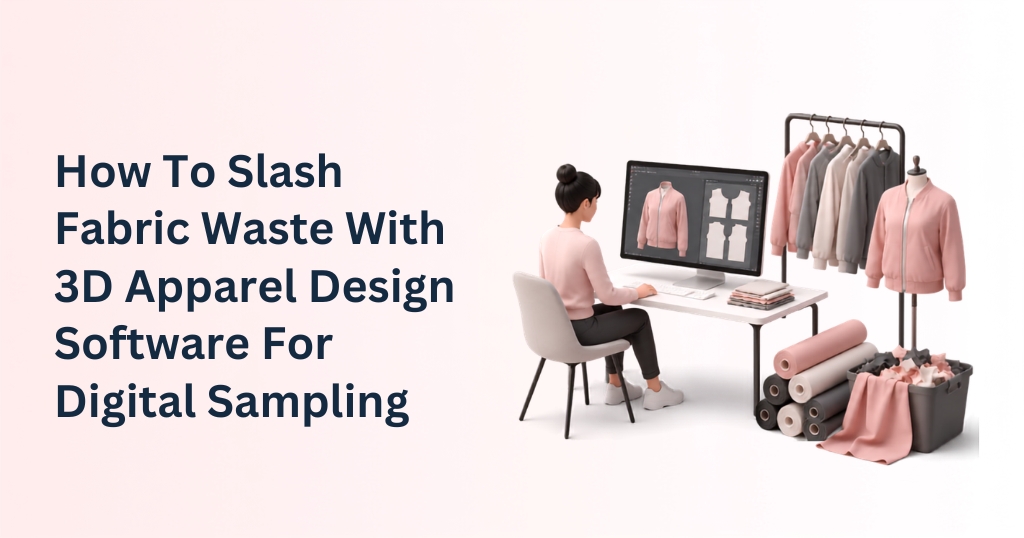
By transitioning to a specialized 3D apparel design software environment, technology leads and operations managers can simulate exact fabric behaviors, assess draping characteristics, and verify structural fits on parameterized digital body avatars before activating a single cutting machine.
Evaluating a transition to virtual prototyping requires analyzing both the technical capabilities of the rendering engine and its broader operational compatibility. The following sections establish a practical framework covering technical selection criteria, financial ROI metrics, and systemic integration requirements essential for validating a scalable deployment.
Summary
- Advanced 3D apparel design software replaces physical prototyping with digital sampling to eliminate pre-production textile waste.
- Legacy physical sampling often leads to multiple design revisions, increasing material waste, production delays, and overall development costs.
- Enterprise 3D apparel design software automates workflows by linking pre-defined design modules directly to real-time inventory and pricing.
- Technical buyers must prioritize real-time 2D-to-3D pattern synchronization and open API architectures during software evaluation.
- Migrating to an on-demand 3D apparel design software shortens validation cycles to hours and protects long-term profitability.

Why Is Traditional Physical Sampling Failing Modern Apparel Enterprises?
Traditional physical prototyping processes are fundamentally incompatible with modern demands for agility, sustainability, and lean supply chain management. The manual creation of physical prototypes introduces extensive lag times (typically 4 to 8 weeks per sampling iteration) due to international pattern transport, localized adjustments, and material sourcing delays. This slow velocity restricts a business’s ability to capitalize on volatile, real-time market trends.
From an environmental and financial compliance standpoint, the legacy model incurs massive material losses. Approximately 15% of raw textile yardage is lost strictly as scrap during the initial cutting phases of sample development.
When 30% of the completed garments are purged following client reviews, the embedded capital loss becomes a permanent drag on corporate gross margins.
By switching to 3D apparel design software, the entire validation loop moves to the cloud. Instead of waiting weeks for a physical shirt or suit sample to arrive from an offshore manufacturing facility, stakeholders interact with a high-fidelity digital twin. Changes to stitch lines, custom placements, and fabric selections are executed programmatically in minutes, completely avoiding the pre-production material waste loop.
What Features Define the Best 3D Clothing Design Software Options?
The capability of 3D apparel design software to eliminate material waste depends entirely on the technical precision of its underlying simulation engine and its user accessibility. To help enterprise buyers systematically audit potential software platforms, the table below outlines the primary functional modules, parameter controls, and direct business outcomes of enterprise customization systems.
3D Apparel Design Software Capabilities
| Customization Tool Category | Essential Features & Parameter Fields | Backend Automation Mechanics | Business Impact |
| Shirt Design Systems | Pre-defined collar/cuff templates, multi-angle previews (front, back, folded), material zoom, elbow patches, accent monograms. | Auto-compiles user selections into localized multi-currency line items; generates interactive visual layers. | Lowers front-end design friction; allows non-technical users to build production-ready patterns in under 5 minutes. |
| Suit & Tailoring Engines | Multi-angle jacket/vest/pant views, lapel styles, pocket configurations, vent options, pant fastening variables. | Connects digital material libraries directly to inventory databases; updates pricing dynamically per fabric grade. | Eradicates manual measurement entry errors; reduces physical fabric swatching costs by up to 80%. |
| Web-to-Print Print Engines | Text rotation, clipart/shape upload, background manipulation, design erase/undo/redo, canvas drag-and-drop. | Generates print-ready vector files (PDF/SVG) featuring automated bleed boundaries, crop lines, and color profiles. | Automates corporate or reseller reordering pipelines; eliminates pre-print prepress setups entirely. |
How Does 3D Apparel Design Software Systematically Eliminate Material Loss?
To evaluate the operational ROI of a 3D garment simulation platform, technical buyers must analyze exactly how digital workflows intercept and replace traditional material-wasting steps throughout the product development lifecycle.
- Algorithmic Nesting and Marker Optimization: Advanced apparel CAD software features cloud-driven nesting algorithms that calculate the absolute tightest configuration for multi-size pattern pieces on a specific fabric width. By running these calculations prior to physical textile sourcing, companies cut factory-floor markers with a clear understanding of exact material consumption, frequently reducing standard cutting-room scrap allocations.
- Physics-Based Fabric Performance Simulation: True digital sampling goes far beyond basic 3D graphics. The software utilizes deep engineering parameters, including bend resistance, shear stiffness, fabric weight, and stretch coefficients, to mirror how real materials hang, stretch, and move on a body. This allows pattern makers to identify tension bottlenecks, fabric pulling, or fit flaws directly on the digital model, ensuring that the first physical sample cut matches production specifications perfectly.
- Real-Time Pattern to 3D View Synchronization: When an engineer alters a seam line or adjusts a sleeve pitch within integrated fashion CAD software, the 3D model re-renders instantly. This eliminates the traditional, multi-week feedback loop between independent pattern design departments and prototyping sample rooms.
Key Statistics
- Annual global textile wastage stands at 92 million tonnes.
- Fashion industry’s global emissions will rise by 30% by 2030.
- 30% of the physical garments never sold end up in landfills & incinerators
Which Selection Criteria Matter Most When Evaluating 3D Garment Design Software?
When comparing enterprise 3D apparel design software platforms, buyers should avoid relying solely on basic interface aesthetics. Instead, technical stakeholders must evaluate core architectural capabilities to ensure long-term usability and clear financial returns.
- Dynamic 2D-to-3D Pattern Synchronization: Ensure the solution offers an absolute real-time link between the 2D pattern data and the 3D visual canvas. If an operations team changes an internal dimension or moves a grading point on a 2D layout, the 3D drape must update instantly to flag any structural stress or fit issues.
- Comprehensive Material and Trim Libraries: The platform must provide an open, expansive digital materials catalog that supports custom configuration. System administrators need the capability to upload unique fabric definitions, customize texture resolutions, map realistic surface finishes, and assign tiered pricing models directly via the central administrative control panel.
- Native CAD, PLM, and ERP Integration Capabilities: High-performing software cannot operate as an isolated silo. It must offer robust, well-documented REST APIs and native data export options (such as production-ready DXF, AAMA/ASTM, or complete Tech Pack formats). This ensures smooth data transfers into existing Product Lifecycle Management (PLM) systems, automated fabric cutters, and enterprise resource planning frameworks.
If you’re still evaluating, this guide on how to choose the best apparel design software for business growth walks you through key decision factors in detail.
What Tech Infrastructure Is Needed for Enterprise 3D Apparel Design Software?
Successfully launching a modern 3D apparel design software environment across an international B2B production ecosystem requires a scalable, cloud-first infrastructure strategy.
- Cloud Architecture and Collaboration Modalities: Enterprise 3D apparel design software platforms must utilize secure cloud hosting models to enable instant, browser-based access to complex 3D assets. This allows global teams to conduct collaborative design reviews, modify patterns, and approve custom orders simultaneously without experiencing local performance bottlenecks or version conflicts.
- E-Commerce Extensibility and Responsive Front-Ends: For business models that feature consumer-facing configuration screens, the rendering engine of the 3D apparel design software must be light enough to load across mobile and desktop browsers alike. Maintaining an identical codebase across different touchpoints guarantees a cohesive user experience and lowers ongoing IT maintenance costs.
- Production File Generation and Automated Output: The 3D apparel design software must automatically convert approved 3D customizations into exact, production-ready manufacturing outputs, including layered vector files, nested cutting maps, and fully populated Bills of Materials (BOMs), completely removing manual data transcription steps.

Conclusion
Implementing advanced 3D apparel design software represents a fundamental operational upgrade that directly protects corporate operating margins. By shifting traditional prototyping workflows into high-fidelity digital design environments, garment manufacturers, custom tailors, and print service providers systematically eliminate pre-production textile waste, accelerate go-to-market speed, and eliminate costly data transcription errors.
As regulatory compliance around supply chain sustainability tightens globally, the transition away from high-waste physical sampling is rapidly changing from an optional efficiency target into a core requirement for enterprise profitability.
Selecting a flexible, API-driven design framework ensures that your production pipelines remain lean, scalable, and fully optimized for the future of on-demand digital manufacturing.
To see how these capabilities integrate with your specific operational ecosystem, aligning your existing workflows with enterprise-grade customization technology is a practical next step. Connect with the iDesigniBuy team to witness a comprehensive demonstration of apparel design software today.
Frequently Asked Questions
1. How long does it take to onboard an enterprise design team onto 3D apparel design software?
3D apparel design software onboarding timelines typically range from 4 to 8 weeks, depending on the complexity of your current pattern inventory. The process involves migrating existing 2D pattern blocks into the system, establishing connected digital fabric libraries, and training design and production teams on parametric grading. Selecting software with an accessible, non-technical user interface significantly minimizes initial training hurdles.
2. Can 3D clothing design software integrate directly with existing PLM and ERP platforms?
Yes. Enterprise-grade 3D clothing design software features native REST API frameworks and structured data export formats like DXF, AAMA, and automated Tech Packs. This allows engineering teams to establish automated data linkages with standard Product Lifecycle Management (PLM) and Enterprise Resource Planning (ERP) databases, ensuring seamless synchronization across design specs, live inventory levels, and production workflows.
3. Does the rendering engine support complex fabrics like heavy wools, performance knits, or leather?
Advanced 3D apparel design software relies on physics-based rendering engines that simulate complex textile properties, including shear stiffness, warp/weft stretch, thickness, and precise fabric weight. By accurately calculating these physical attributes, the system correctly simulates the natural drape, tension points, and movement profiles of diverse materials, ranging from lightweight performance knits to structured tailoring cloths.
4. How does digital prototyping accelerate overall time-to-market for new apparel lines?
Traditional physical sampling workflows often take 4 to 8 weeks due to continuous material sourcing, prototype fabrication, and global shipping loops. Transitioning to digital fashion design shortens this validation phase down to days or hours. Design modifications, sizing changes, and fabric swaps are processed instantly via cloud dashboards, allowing brands to launch collections much faster.
5. What hardware or client-side infrastructure is required to run these custom design tools?
Modern platforms utilize cloud-based rendering architectures, meaning complex geometric and physics calculations are processed on secure remote servers. Consequently, end users do not need high-end local workstations; the interactive design modules run smoothly across standard web browsers on laptops, tablets, and mobile devices without sacrificing speed or performance.
6. What is the average financial ROI timeline for an enterprise software deployment?
Most apparel operations realize complete capital cost recovery within 6 to 12 months post-implementation. Financial returns are driven by the immediate elimination of physical sample production costs, substantial reductions in international sample shipping expenses, and lower raw material consumption via precise digital pattern nesting.