In the hyper-competitive e-commerce marketplace of modern times, consumers no longer settle for one-size-fits-all products. They demand unique, tailor-made experiences that reflect their individual, personal style.
From bespoke apparel and custom jewelry to personalized promotional merchandise, the global demand for product customization is rewriting the rules of retail.
However, scaling this level of personalization introduces massive production challenges. Operating a commercial printing or personalized apparel business requires a delicate balance between limitless design flexibility and strict operational efficiency.
Integrating a dedicated product customization engine, such as iDesigniBuy’s advanced tailoring software and web-to-print solution, addresses this operational bottleneck, effectively transforming passive online browsing into an interactive, high-value purchasing experience.
This article evaluates how specialized visual product customization tools automate complex production workflows, drastically mitigate costly order errors, and directly accelerate enterprise-level conversions.
Key Insights
- Product customization software helps increase average order value (AOV), reduce cart abandonment, and deliver engaging, personalized buying experiences.
- Automated design validation, print-ready file generation, and real-time previews minimize production errors, returns, and manual workflows.
- Seamless integration with ERP, CRM, inventory, and eCommerce platforms enables efficient, end-to-end order processing and fulfilment.
- Scalable architecture, centralized asset management, and dynamic pricing support business growth while maintaining operational efficiency.
- The right product customization platform not only streamlines production but also provides customer insights that improve inventory planning, product strategy, and long-term profitability.

Why is Product Customization an Essential Driver for eCommerce Growth?
The primary business value of offering product customization lies in its ability to dramatically increase Average Order Value (AOV) and diminish high cart abandonment rates. Traditional web stores limit buyers to static stock-keeping units (SKUs), which often leads to friction when buyers require tailored specifications. When a business implements a robust custom product builder, it transfers creative control to the end user while maintaining strict, pre-defined operational guardrails established by the administrator.
From an operational standpoint, this self-service model shifts the labor-intensive proofing phase to the consumer. Instead of a sales representative manually exchanging emails with a client to confirm dimensions, colors, or text placements, the customer visualizes the final output in real-time. This interactive validation provides several distinct advantages:
- Minimized Return Rates: By utilizing a platform that provides accurate 3D rendering or multi-angle previews, customers gain precise expectations of the physical item, reducing variance-based returns.
- Willingness to Pay a Premium: B2B and B2C buyers consistently demonstrate a higher price tolerance for items they have actively configured to meet specific brand guidelines or personal styles.
- Accelerated Sales Cycles: Eliminating back-and-forth mock-up approvals allows print service providers to compress order processing timelines from days to minutes.
If you are interested in learning more about how a product customization software is integral to driving B2B ecommerce growth, here is a complete guide for your reference.
What Core Features of Product Customization Software Eliminate Order Inaccuracies?
To support high-volume commercial printing and manufacturing, an enterprise-grade platform must rely on structured, automated rules rather than simple visual overlays. Understanding the critical features of product customization software allows operations managers to ensure that what the customer creates on screen perfectly matches what the factory floor produces.
The following architectural capabilities are vital to maintaining automated print-readiness and a seamless customer experience:
- Dynamic Print-Ready Output Generation: The system must automatically convert front-end configurations into high-resolution vector files (such as PDFs, SVGs, or DXF files) complete with exact cut lines, bleed areas, and color profiles.
- Pre-Defined Attribute Masking and Constraints: To protect brand integrity and prevent manufacturing errors, administrators can set strict boundaries. For example, a shirt design tool might restrict monogramming to specific coordinates or limit font sizes on a personalized business card template.
- Cross-Device Responsiveness and Fluid UI: High-converting platforms deploy a mobile-responsive layout that maintains precise rendering engines across computers, laptops, and tablets without requiring specialized applications.
- Advanced Material and Texture Visualization: Utilizing sophisticated zoom-in engines, fabric libraries, and texture mapping ensures that complex surfaces, such as performance textiles, leather grain, or metallic foils, are accurately displayed to the user.
When evaluating a custom product builder, prioritizing these technical parameters guarantees that the front-end user experience directly feeds your existing print and fulfilment infrastructure without introducing manual data entry points.
How Interactive Product Customization Improves Conversions?
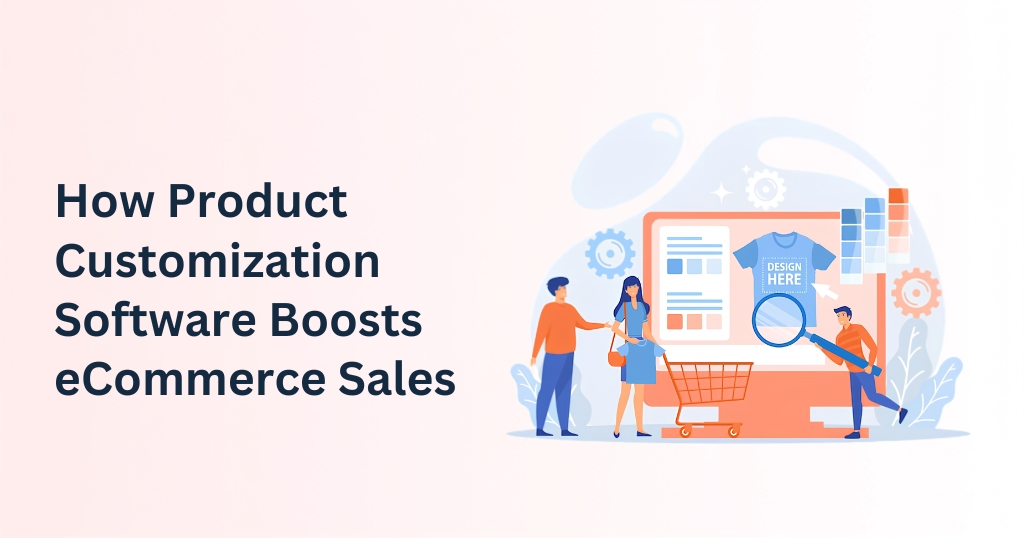
A product customization software transforms a standard online storefront into an interactive buying experience where customers actively participate in designing their products. Instead of selecting from fixed product variations, buyers can personalize colors, text, graphics, materials, and other attributes while viewing real-time previews of their choices.
Such an engagement in customization builds customer confidence and reduces hesitation during the purchasing journey. As customers invest time creating a product that reflects their preferences, they become more committed to completing the purchase, leading to lower cart abandonment rates and higher conversion rates. Personalized products also command greater perceived value, making customers more willing to pay for premium materials, advanced finishes, or additional customization options.
Real-time pricing updates ensure complete transparency throughout the process, eliminating unexpected costs at checkout. By combining an intuitive user experience with personalized product offerings, businesses create stronger customer satisfaction, encourage repeat purchases, and increase average order value without relying solely on discounts or promotional campaigns.
How Do Advanced Configuration Tools Streamline the Print Production Workflow?
An optimized configuration engine connects front-end customer choice with automated back-end manufacturing. By deploying a unified custom product builder, companies eliminate manual prepress proofing. This is crucial for managing high volumes of low-run, highly personalized orders.
The table below demonstrates how the features of product customization software directly translate into tangible operational efficiencies and improved business outcomes:
| Core Software Capability | Operational Function | Business Impact |
| Automated Prepress Automation | Generates immediate, high-resolution vector outputs (SVG/PDF) containing precise bleeds and cut marks. | Drastically cuts labor costs and eliminates manual prepress steps. |
| Pre-Configured Layout Templates | Locks print boundaries, font parameters, and resolution requirements automatically. | Prevents production mistakes and reduces material waste. |
| Dynamic Bill of Materials (BOM) | Updates necessary fabric yards, ink volume, and hardware requirements in real time. | Optimizes inventory management and provides accurate job costing. |
| Localized Currency & Language Engines | Adjusts front-end interfaces dynamically based on user location data. | Minimizes international friction and grows global market share. |
| Multi-Angle 3D Product Rendering | Offers immediate visual feedback through 360-degree previews and texture zooming. | Lowers return rates and improves checkout conversion rates. |
How To Choose the Right Product Customization Software for Long-Term Scalability?
To successfully choose the right product customization software, business owners must look beyond current production demands and actively plan for future catalog expansion. A common mistake is investing in niche, single-category tools that fail when a business decides to expand from apparel sublimation into hard-surface promotional goods, corporate gifting, or complex signage.
To guarantee long-term operational viability, your configuration software must provide a unified management dashboard capable of handling diverse manufacturing rules across multiple product segments. Consider the following structural criteria during your vetting process:
- Extensible Architecture: The software must allow administrators to seamlessly add diverse product lines, ranging from technical tailored apparel to engraved corporate awards, without writing custom code.
- Scalable Cloud Infrastructure: High-volume commercial operations experience significant traffic surges; the platform must maintain rapid rendering speeds and zero downtime during peak seasonal periods.
- Unified Asset Management: A centralized backend should govern all fabric libraries, pre-designed templates, clipart repositories, and font configurations across all connected digital storefronts.
- Flexible Pricing Rules: Look for engines that support sophisticated pricing matrices, allowing you to easily adjust margins based on setup fees, layer counts, material types, or volume-based bulk discounts.

Conclusion
Deploying a modern product customization software solution goes far beyond offering simple text engraving or color changes. For forward-thinking enterprise leaders, true personalization serves as a foundational data source that reveals real-time shifts in consumer preferences.
By tracking the exact configurations, colors, and features that clients interact with, brands gain access to direct market intelligence. This granular data allows companies to optimize supply chains, forecast raw material needs accurately, and refine inventory strategies based on real consumer choices rather than backward-looking sales forecasts.
As automated production and smart manufacturing continue to advance, the link between front-end interactive design tools and back-end fulfilment networks will grow even stronger. Businesses that integrate automated, print-ready configuration ecosystems position themselves to capture high-margin revenue while building long-term operational resilience.
To see how these advanced product customization tools can seamlessly integrate with your current production workflow, contact the iDesigniBuy team today to schedule an expert-led, technical product demonstration.
Frequently Asked Questions
1. How does product customization software manage complex pricing models for multi-attribute items?
Enterprise-grade product customization software for ecommerce platforms uses a dynamic pricing matrix managed from the administrative back end. Instead of fixed pricing, it calculates costs in real time by combining base costs, component surcharges (such as premium zippers or specialized textures), and variable material costs (such as fabric usage or printing ink). This ensures customers always see accurate prices that reflect production costs and target profit margins.
2. Can a custom product builder integrate with legacy ERP and inventory systems?
Yes, robust software solutions feature extensive API layers and webhooks designed to connect seamlessly with legacy Enterprise Resource Planning (ERP) and inventory management systems. When a user finalizes a configuration, the system automatically pulls raw materials from inventory and checks availability before finalizing the sale, ensuring out-of-stock items cannot be ordered.
3. What are the core features of product customization softwarerequiredto prevent production errors?
To eliminate production mistakes, the best product configuration software must feature strict bounding boxes, automated image resolution verification, pre-defined style rules, and instant print-ready file generation (such as high-res vector PDFs or SVGs). These automated validation checks ensure that customers can only submit designs that exactly match the physical capabilities and tolerances of your production machinery.
4. Is the user interface for these advanced tailoring and configuration tools mobile-responsive?
Modern product customization software such as iDesigniBuy are built with a mobile-first philosophy, utilizing adaptive, responsive layouts that scale to any screen size, whether on a smartphone, tablet, laptop, or desktop computer. This consistent user experience ensures high conversion rates across all device types without requiring customers to download third-party applications.
5. What timeline should an operation expect for full onboarding and implementation?
Implementation schedules depend on your catalog size and system complexity, but most standard deployments using reliable software for ecommerce range from a few weeks to a few months. This timeline covers catalog setup, defining design constraints, setting up the asset library, running integration tests with your shopping cart, and validating print-ready file outputs.