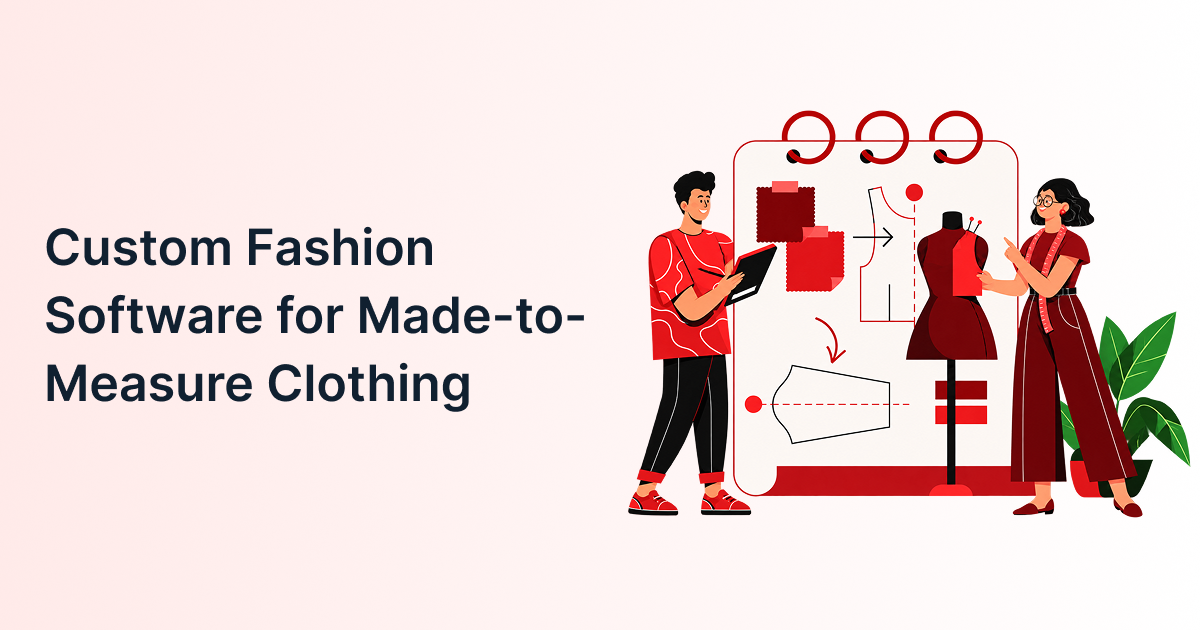
Made-to-measure clothing businesses need technology that connects customer preferences, body measurements, garment design, pricing, and production requirements. Custom fashion software helps businesses manage these activities through a digital workflow, reducing the manual effort involved in handling individual orders.
For apparel brands, tailoring businesses, and B2B clothing manufacturers, the challenge is deciding which capabilities deserve investment. A visual design tool might help customers personalize garments, while a dedicated tailoring platform could handle measurements and style configurations. Some businesses need both, along with connections to their existing eCommerce, order management, or production systems.
The right choice depends on how your business sells, designs, and produces clothing. Evaluating these requirements early helps technology leaders avoid buying a tool that solves one customer-facing problem while leaving operational bottlenecks untouched.
How Does the Made-to-Measure Clothing Process Work?
Made-to-measure clothing begins with an existing garment design or base pattern that is adjusted to suit an individual customer’s measurements. The process combines personalized fit with a defined production method.
A typical workflow
- Design selection: The customer chooses a garment style, fabric, and available design options.
- Measurement capture: Staff or customers record the required body measurements.
- Fit adjustment: The measurements inform the required pattern modifications, subject to the garment’s construction rules.
- Order confirmation: The customer approves the design, specifications, and price.
- Production and fitting: The garment is manufactured and checked for fit before delivery.
Each step creates information that the next team needs. Custom fashion software helps organize these details and reduce repeated data entry, particularly when orders arrive through multiple sales channels.
Made-to-Measure vs. Made-to-Order vs. Bespoke Clothing: Quick Comparison
| Clothing model | What changes for the customer? | Typical operational requirement |
| Ready-to-wear | Customer selects an existing size and design | Inventory and size management |
| Made-to-order | Production begins after an order is placed; personalization depends on the offering | Order scheduling and production tracking |
| Made-to-measure | An existing pattern is adjusted using individual measurements | Measurement and fit management |
| Bespoke | A garment is developed around an individual brief, often with a new pattern and multiple fittings | Detailed design records and fitting history |
Why Made-to-Measure Brands Need Specialized Fashion Software?
Made-to-measure businesses need specialized software because each order can carry different measurements, fabric preferences, design choices, and fitting requirements. Standard retail workflows often assume that customers select an existing size and place an order. Custom production follows a different process.
Consider a brand selling tailored shirts to corporate clients. Each employee may require a different fit, collar style, sleeve length, and fabric. Managing these details through email attachments and spreadsheets creates opportunities for errors.
Custom fashion solution like an apparel design software can help the business record those choices, maintain customer-specific information, and pass approved specifications to the appropriate team.
The need becomes stronger when a business experiences:
- Rising volumes of personalized orders.
- Repeated measurement corrections or customer clarifications.
- Delays between design approval and production.
- Difficulty retrieving previous customer specifications.
- Plans to introduce online ordering or serve customers across locations.
Different Types of Custom Fashion Software
The software category matters because different products solve different parts of the clothing customization process.
| Software category | Primary purpose | Best suited for |
| Tailoring software | Records measurements, garment preferences, and tailoring requirements | Tailors and made-to-measure businesses |
| Apparel design software | Supports garment design and visual development | Fashion designers and apparel brands |
| Product customization software | Let’s customers personalize predefined garments online | eCommerce and customized clothing businesses |
| Custom clothing design software | Supports garment configuration and design workflows, depending on the product | Businesses selling configurable apparel |
| ERP or production management software | Manages wider business and manufacturing operations | Growing brands with complex production needs |
A business may require more than one category. A tailoring company could use a customer-facing design interface alongside a system that manages measurements and order status.
For example, iDesigniBuy offers tailoring software with capabilities such as custom measurement inputs, style configurations, fabric libraries, and garment previews. Businesses should assess the specific functions available in a proposed implementation rather than assume every product in a category offers the same capabilities.

6 Most Common Operational Bottlenecks in Custom Clothing Businesses
1. Inconsistent measurement records
Measurements captured through in-store consultations, online forms, or sales representatives often follow different formats. Without a standardized system and version control, teams may rely on outdated measurements, increasing the risk of fitting errors and rework.
2. Repeated design revisions
Customers frequently request modifications to fabrics, trims, collars, cuffs, sizing, or styling details. When every change requires manual updates and approvals, design teams spend excessive time on repetitive tasks, delaying order progression.
3. Unclear production instructions
Reference images and design sketches may not provide sufficient detail on measurements, materials, stitching, or finishing requirements. Missing specifications can lead to misinterpretation, production errors, quality issues, and costly corrections.
4. Limited order visibility
Order information is often spread across emails, spreadsheets, design files, and messaging platforms. This makes it difficult for sales and support teams to quickly track approvals, alterations, production status, and delivery timelines.
5. Manual order management
As order volumes grow, manually tracking customer details, design preferences, approvals, and production milestones becomes increasingly complex. Administrative overhead increases, creating bottlenecks that slow operations and affect customer responsiveness.
6. Inefficient alteration tracking
Alteration requests made after fittings are often managed through disconnected notes or conversations. Without a centralized tracking process, teams can miss updates, repeat work, or struggle to ensure every adjustment is completed correctly.
Custom clothing software can address these issues when it maintains a reliable record of customer choices and connects that record to the next operational step.
Warning signs to look for before investing in custom software
- Employees repeatedly enter the same measurements or customer preferences in different systems.
- Staff cannot easily identify the latest approved garment specifications.
- Customer changes lead to pricing discrepancies or production errors.
- Returning customers need their measurement records reconstructed.
- The business wants to offer online customization but lacks a reliable way to transfer orders into production.
Must-Have Features in a Made-to-Measure Fashion Platform
A custom fashion solution should support the full commercial workflow, not simply the appearance of a garment on screen. Evaluate each capability against a real order your business processes.
Measurement and fit management
The system should capture relevant body measurements, associate them with the correct customer, and retain measurement history. Staff should be able to distinguish an initial measurement from a revised or approved version.
Check whether the platform supports garment-specific measurement fields, fit preferences, and notes about alterations.
Garment configuration and visualization
An online clothing design tool should let customers select supported fabrics, colors, styles, and garment details. The available choices should reflect what your business can actually manufacture.
A suit configurator, for example, could allow customers to select lapel styles, lining, buttons, and pocket options. The system should prevent selections that are incompatible with the product’s construction rules.
Pricing and order management
Customization often changes the final price. Fabric grade, additional design elements, special construction, or personalization can affect production costs.
Ask whether pricing updates automatically when customers change their selections. Also check whether the approved configuration, quoted price, order details, and customer notes remain connected.
Production-ready information
The system should provide production teams with usable specifications. Depending on the workflow, these might include measurement sheets, approved design references, material selections, and order instructions.
Integration and access controls
Check whether the platform can exchange data with your existing eCommerce, CRM, ERP, or order management systems. Review user permissions, revision history, data export options, and the process for backing up customer records.
A feature that looks useful during a demonstration has limited value if employees must re-enter the same information elsewhere.
Custom Fashion Software vs. Off-the-Shelf Apparel Solutions
Custom fashion platform is worth evaluating when standard apparel tools cannot accommodate the measurement, configuration, and production rules that define your business. Off-the-shelf solutions can still be suitable when requirements are straightforward.
| Evaluation factor | General apparel solution | Specialized fashion platform |
| Standard size-based orders | Usually sufficient | Can support them |
| Individual measurements | Depends on available features | Can be designed around the workflow |
| Garment-specific configuration | May have limited options | Can support defined customization rules |
| Tailoring and alteration records | May require workarounds | Can be included where supported |
| Integration requirements | Depends on connectors | Depends on architecture and implementation |
| Initial implementation | Often simpler for standard workflows | May require more planning and configuration |
| Long-term flexibility | Depends on product roadmap | Depends on customization and maintenance arrangements |
The important distinction is fit between the software and the operating model. A specialized platform is not automatically better if the business only needs basic personalization. Also, customization and integration capabilities depend on the individual product and implementation, not simply its category.
For a broader perspective on platform selection, read iDesigniBuy’s guide to custom apparel software for startups. It covers the relationship between customization capabilities, integrations, and business growth.
How Automation Improves Order Accuracy and Production Efficiency?
Automation reduces repetitive data entry and helps preserve customer-approved specifications throughout the order lifecycle.
A typical digital workflow might follow this sequence:
- The customer chooses a garment and available customization options.
- The system captures measurements and preferences.
- Pricing updates according to the selected options and applicable rules.
- The customer reviews the design and submits the order.
- Staff verify the specifications before production.
- The approved information is passed to the relevant production workflow.
The final review remains important. Automation cannot compensate for incorrect measurements, unrealistic product rules, or inaccurate information supplied by a customer.
Custom apparel software is most useful when it removes avoidable repetition while preserving appropriate human checks. For example, an order with a non-standard sleeve length could trigger a review before the work reaches the cutting stage.
How Software Reduces Alterations, Returns, and Rework?
Better data capture and order verification can potentially reduce preventable errors, although software alone cannot guarantee a perfect fit. For made-to-measure brands, the practical objective is to identify errors before production or dispatch.
A well-designed workflow can help teams:
- Validate required measurement fields before an order is submitted.
- Compare new measurements with previous records where appropriate.
- Require approval for unusual or conflicting specifications.
- Keep the approved design attached to the order.
- Record alterations and use that history during future orders.
Clothing customization software should also distinguish between a measurement error, a manufacturing defect, and a customer-requested style change. Each issue has a different cause and requires a different corrective action.
Managing Measurements, Patterns, and Fit Data in One System
Centralized fit data helps staff retrieve the right information without reconstructing a customer’s preferences for every new order.
A useful customer record can include body measurements, preferred fit, previous garment specifications, alteration history, and the date of the latest measurement. Access should be controlled because body measurements are personal customer information.
Pattern management requires a separate evaluation. Some businesses need parametric pattern drafting or connections to specialist patternmaking tools. Others only need to send approved measurements and design specifications to an existing production team.
Before purchasing custom clothing design software, ask how measurement changes affect patterns, whether revisions are traceable, and whether data can be exported in a format your production tools support.
The goal is to preserve the relationship between a customer’s measurements, the selected garment, and the actual production instructions.
Enhancing Customer Experience Through Personalization Technology
Customers are more likely to complete a customization journey when they can understand their options and see what they are ordering.
A useful digital experience should explain available choices, show garment previews, communicate price changes, and make it easy to correct selections before placing an order.
For example, a customer designing a formal shirt could select a fabric, collar, cuffs, and fit preference. A preview would help them review the design before submitting the request.
An apparel design software solution can support visual garment customization, while a dedicated t-shirt design tool is more relevant to businesses offering customizable casualwear, uniforms, or branded apparel.
These tools serve different product requirements. A business should test the customer journey on mobile devices, verify that the available options match its production capabilities, and confirm that saved designs can be retrieved when needed.
Measuring ROI from Custom Fashion Software
ROI should reflect measurable changes in business performance, including labor costs, order throughput, rework, and customer retention.
Start by recording current performance before implementation. Useful baseline metrics include:
- Average time required to process an order.
- Staff hours spent on measurement entry and design revisions.
- Cost of alterations and preventable production errors.
- Average time between order approval and production readiness.
- Number of customized orders handled per employee.
- Percentage of customers who place repeat orders.
A basic calculation could be:
Net annual benefit = annual operating savings + incremental contribution from additional orders − annual software and operating costs.
ROI = (net annual benefit ÷ total implementation investment) × 100
Include software fees, integration work, staff training, maintenance, and internal administration in the investment calculation.
For example, if automation saves 12 staff hours per week, calculate the annual value using the actual loaded labor cost. Then add verified savings from reduced rework. Avoid counting the same time savings twice.
Custom fashion software should be judged against the operational or commercial problem it is expected to solve. Set a review period and compare actual results with the baseline.
Custom Fashion Solution Implementation Considerations for Brands
A phased rollout gives teams an opportunity to validate the workflow before extending it across the business.
Phase 1: Select a representative product line.
Choose a garment category with meaningful customization volume and document its measurement fields, available options, pricing rules, and approval requirements.
Phase 2: Configure the workflow.
Define how customers submit information, how staff verify it, and how approved specifications reach production.
Phase 3: Test integrations and exceptions.
Include revised measurements, unusual requests, order changes, cancellations, and incomplete submissions. Confirm that the right version of each specification reaches the right team.
Phase 4: Train users and measure results.
Train sales, design, tailoring, and production staff according to their responsibilities. Track the same operational metrics established before implementation.
Also clarify who owns customer data, who can change product rules, and how future updates will be tested. These decisions become more important as the business expands into new product categories or sales channels.
Checklist for Choosing the Right Made-to-Measure Software
Use this checklist during vendor evaluation. Ask each shortlisted provider to demonstrate the requirements against an actual garment and a representative order.
- Can the system capture and maintain customer-specific measurements?
- Can it represent the styles, fabrics, and options we sell?
- Does it prevent invalid combinations and support relevant pricing rules?
- Can customers review and approve their selections?
- Does production receive complete, approved specifications?
- Can staff track revisions and retrieve previous orders?
- Does the platform integrate with our existing business systems?
- Are data ownership, security, and export arrangements clear?
- Can administrators update products without unnecessary developer involvement?
- Are implementation costs, support terms, and ongoing maintenance documented?
- Can the vendor demonstrate how success will be measured?
Request a demonstration that covers the entire order journey. A polished product preview is useful, but the most revealing test is what happens after the customer approves the garment.

Key Takeaways
- Choose software according to your made-to-measure workflow, including measurement capture, garment configuration, pricing, and production handoff.
- Prioritize accurate fit records and structured order data to reduce manual corrections and rework.
- Compare specialized tailoring platforms, visual design tools, and broader customization systems before making a purchase.
- Calculate ROI using measurable changes in processing time, alterations, order capacity, and implementation costs.
Conclusion
The strategic decision is whether your business wants to make bespoke clothing easier to sell, easier to produce, or both. That answer should guide the technology investment. A platform that fits your current workflow and can accommodate credible growth plans is usually a stronger choice than one selected for an impressive feature list.
Before committing, define the business outcomes you expect and test them with a representative order. Discuss integration requirements, future product expansion, and ongoing ownership with shortlisted vendors. If you are assessing options for your made-to-measure business, iDesigniBuy platform demonstration can help you evaluate how its customization capabilities could fit your requirements.
Frequently Asked Questions
1. What is custom fashion software?
Custom fashion software helps apparel businesses manage garment personalization and related workflows. Depending on the solution, it can support measurement capture, design configuration, pricing, customer records, order processing, and production handoff.
2. How does made-to-measure software differ from standard apparel software?
Made-to-measure software accommodates individual measurements and garment-specific preferences. Standard apparel software often focuses on predefined sizes and product variants, so businesses should verify whether it supports their tailoring and fitting requirements.
3. Can custom fashion software integrate with an existing ecommerce website?
Yes, depending on the platform’s architecture and available integrations. Ask vendors to demonstrate how customer selections, measurements, pricing, approved designs, and order information move between your website and downstream business systems.
4. Does custom fashion software eliminate fitting errors?
No. It can improve data consistency and identify missing or conflicting information, but accurate measurements, sound patternmaking, skilled production, and appropriate fitting checks remain necessary to achieve the intended garment fit.
5. How should businesses calculate the ROI of custom fashion software?
Measure changes in order processing time, staff effort, alteration costs, specification errors, and order capacity. Compare verified annual benefits against software fees, implementation, integrations, training, maintenance, and administration expenses.
6. What should businesses look for when selecting clothing customization software?
Prioritize measurement management, garment configuration, pricing rules, design approval, production-ready specifications, integrations, data security, and support. Ask shortlisted vendors to demonstrate a complete order using your actual products and business requirements.