The global fashion landscape is transitioning towards on-demand manufacturing and hyper-personalization. Modern consumers no longer want mass-produced off-the-rack garments. They demand unique apparel tailored to their specific tastes, fits, and styles.
For brands, retailers, and print-on-demand operators, selecting the right clothing customization software is a critical operational decision that directly impacts user experiences, return on investment (ROI), and supply chain efficiency.
In 2026, deploying scalable apparel customization software is no longer a luxury but an operational baseline to eliminate manual errors and keep up with agile market demands. iDesigniBuy is at the forefront of enabling businesses to fully harness the transformative power of best clothing customization solutions.
This evaluation guide serves as an enterprise blueprint for B2B apparel brands, technology leaders, and fashion entrepreneurs looking to invest in the best clothing customization software for businesses to secure sustainable market advantages.
Key Takeaways
Here are the key insights you will acquire by the end of this article:
- Surging consumer demand for personalized apparel makes automated order workflows and real-time 3D visualization an operational baseline.
- High-converting platforms require mobile-responsive UIs, multi-decoration method support, and seamless integration with top ecommerce engines.
- Advanced customization platforms eliminate error-prone manual pre-press workflows, lower product return rates, and optimize manufacturing line speed.
- Long-term business scalability depends on evaluating cloud performance, open APIs, and production automation rather than base subscription costs.

Why Clothing Customization Software Matters More Than Ever in 2026?
Modern apparel brands require dedicated software because consumer demand for immediate, error-free product personalization makes manual order processing completely obsolete.
Customer Expectations Have Changed
Today’s shoppers expect frictionless personalized shopping journeys. When configuring a custom garment, they demand instant visual validation, precise pricing updates based on selected styles, and absolute clarity on delivery times.
Advanced apparel customization software provides instantaneous high-fidelity previews, giving shoppers the ultimate confidence to finalize their purchases without hesitation, which significantly reduces shopping cart abandonment rates.
Manual Design Processes No Longer Scale
Relying on legacy methods like manual email-based approvals, back-and-forth phone calls, and manual graphic mockups leads to crippling bottlenecks. These outdated methods introduce critical communication gaps, costly production errors, and severe fulfilment delays.
Automated custom apparel software replaces these error-prone manual steps by converting customer-facing configurations directly into precise, print-ready production files.
Legacy Design Tools Are Falling Short
Traditional, static configurators lack the modern cloud infrastructure required to support high-volume on-demand production. Modern enterprise buyers are actively swapping these obsolete tools for dynamic product customizer software ecosystems.
These modern platforms feature cloud-based multi-user collaboration, scalable manufacturing API connections, and intelligent automation suites that dramatically shorten the concept-to-delivery lifecycle.
8 Factors to Consider When Choosing Clothing Customization Software
To secure long-term profitability, businesses must analyze structural capabilities, focusing heavily on front-end user experience, back-end production integrations, AI automation, and cloud performance metrics.
1. Easy-to-Use Product Designer
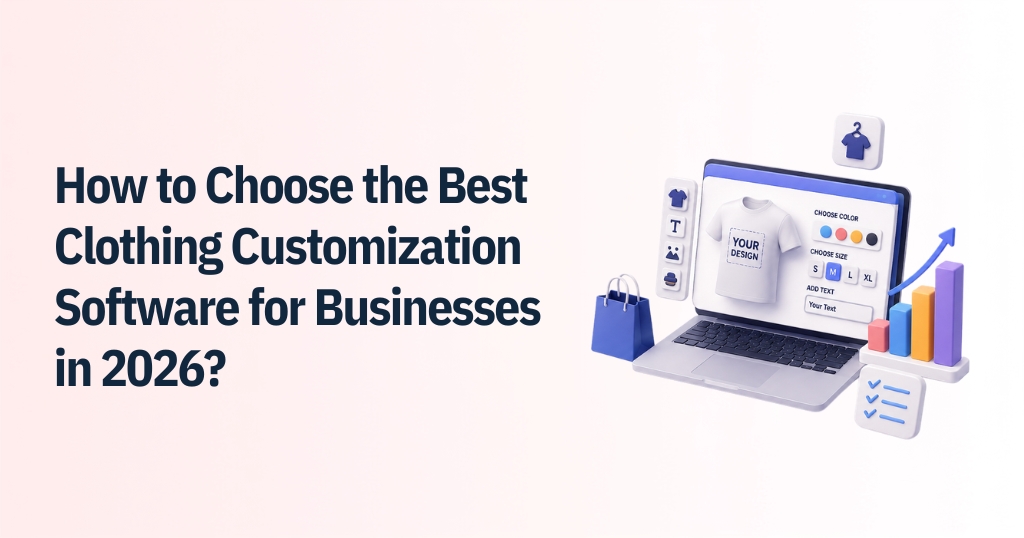
A successful implementation hinges completely on user adoption. The consumer-facing digital canvas must offer a highly intuitive drag-and-drop interface that allows users to place text, upload personal images, and apply custom clipart effortlessly.
Look for an online clothing designer tool that supports rich text typography, robust font libraries, and simple color swap palettes.
The front-end interface should remain completely accessible to casual shoppers while providing advanced, high-precision adjustment layers for professional designers.
2. Support for Multiple Decoration Methods
Platform must understand how various printing and fabrication methods operate. The software needs to apply specific design rules based on whether a garment uses Direct-to-Garment (DTG), Direct-to-Film (DTF), screen printing, intricate embroidery, sublimation, heat transfer, or vinyl applications.
For instance, when configuring embroidery, the product customizer software must evaluate vector lines, translate designs into approximate stitch counts, and enforce clean design boundaries to prevent production complications.
3. Real-Time Product Visualization
Static 2D image previews are no longer sufficient to drive modern conversion rates. Top-tier software uses advanced 3D rendering engines to show texture details, fabric drapes, and precise print placements in real-time.
The system must let users view the custom garment from multiple angles, including detailed front, side, back, and close-up collar perspectives. This transparent visual confirmation ensures what the customer sees on screen perfectly matches the physical item delivered.
4. Ecommerce Platform Integrations
Frictionless operations require your customization suite to link directly to your transactional storefront. Ensure the software offers native, plug-and-play integrations for leading platforms like Shopify, WooCommerce, Magento, and BigCommerce.
A robust connection ensures configured designs, personalized options, pricing rules, and specific design metadata synchronize smoothly with your shopping cart, eliminating the need for tedious manual data entry.
5. AI-Powered Design Assistance
Modern clothing customization software leverages embedded AI models to provide text-to-image art generation, instant background removal, auto-centering, and smart scaling. These automated tools help users refine low-resolution uploads, optimize layout balances, and fix common design flaws before the order hits the factory floor.
6. Mobile-Friendly Customization Experience
With a massive share of global ecommerce traffic originating on mobile screens, your design experience must be optimized for touch interfaces.
The canvas must scale responsively across smartphones and tablets, featuring touch-friendly buttons, smooth image dragging, and fast-loading web assets.
A mobile-optimized workspace ensures conversion rates remain consistently strong, regardless of what device the customer uses.
7. Scalability for Business Growth
Enterprise applications require architectures engineered for long-term expansion. The platform must provide robust multi-store control, deep user permission tiers, and multi-location order routing to manage growth effortlessly.
Choosing highly scalable business clothing design software guarantees your digital infrastructure can handle sudden holiday traffic spikes and growing order volumes without performance drops.
8. Reporting, Analytics, and Business Insights
The software should provide clear dashboard analytics tracking your best-selling custom products, design option popularity, shopping cart drop-off zones, and average design completion times.
These strategic insights allow production teams to optimize raw material inventory, refine marketing focuses, and continuously improve overall shop conversion rates.
In addition to the above aspects, a highly crucial advantage of clothing customization solution is that it reduces fashion waste tremendously. You can read in-depth about it in this comprehensive guide.
Checklist: Evaluating The Clothing Customization Software
| Evaluation Criteria | Why It Matters | Business Impact |
| Product Designer | Drives user engagement and setup adoption. | Higher front-end conversion rates and lower drop-offs. |
| Ecommerce Integration | Connects front-end purchases to order books. | Eliminates manual order entry errors and reduces labor overhead. |
| Production Workflow | Auto-generates print-ready vectors and assets. | Speeds up fulfilment cycles and increases daily throughput. |
| AI Features | Helps users clean up artwork layouts automatically. | Lower pre-press graphic cleanup times and higher order accuracy. |
| Catalog Management | Keeps SKU matrices, sizing, and colors synchronized. | Prevents out-of-stock orders and simplifies product rollouts. |
| Mobile Experience | Accommodates mobile-first shoppers. | Expands mobile purchase volume and maximizes ad spend ROI. |
| Pricing Models | Defines fixed operational costs vs. variable fees. | Protects bottom-line profit margins as unit sales scale up. |
| Technical Support | Delivers fast troubleshooting during launches. | Minimizes system downtime and accelerates time-to-market. |
| API Availability | Enables connections to custom ERPs and warehouses. | Connects easily with existing legacy warehouse systems. |
| Data Security | Safeguards customer data and payment channels. | Ensures global compliance and protects brand integrity. |
Common Mistakes Businesses Make While Choosing Clothing Customization Software
Choosing Based Only on Price
Selecting a platform solely because it has the lowest initial monthly subscription fee can be costly. Cheap applications often lack essential back-end workflow automations, leading to high labor costs from manual order management that quickly wipe out any initial software savings.
Ignoring Workflow Automation
A beautiful front-end configurator is not of much use if your production team must manually download, edit, and re-export every design file. Overlooking automated print-ready production file routing creates major operational bottlenecks as your daily order volumes grow.
Overlooking Integration Capabilities
Opting for standalone software that cannot communicate directly with your existing ecommerce store, CRM, or warehouse ERP isolates your data. This lack of integration forces manual data entry slowing down fulfilment and introduces avoidable transcription errors.
Buying Software That Doesn’t Scale
Basic configuration apps are usually built for small boutique shops with low transaction volumes. Investing in a platform that lacks multi-store capabilities, internationalization features, or open APIs prevents your business from expanding into global markets smoothly.
Not Testing the Customer Experience
Failing to thoroughly test the design tools from a customer’s perspective often leads to clunky interfaces and confusing navigation steps. If your shoppers find the tool frustrating or slow, they will leave your store, resulting in low conversion rates regardless of how good your physical products are.
Who Should Purchase Clothing Customization Software?
Every facet of the modern fashion industry can benefit from embedding advanced custom design software into their digital storefronts:
- Print-on-Demand Operators: Streamline front-end graphic submissions and automate downstream print file preparation.
- Apparel Brands & Retailers: Launch high-margin, personalized product lines without maintaining massive, pre-printed inventory stocks.
- Promotional Merchandise Agencies: Empower corporate clients to upload logos, preview branded apparel, and approve bulk orders autonomously.
- Industrial Uniform Suppliers: Allow corporate clients to manage standardized employee name additions, precise sizing grids, and custom logo placements.
- Athletic Sportswear Brands: Provide sports teams with custom builders to choose team colors, enter player numbers, and arrange sponsor placements.
Why Modern Clothing Businesses Are Choosing Integrated Customization Platforms?
Unified platforms like iDesigniBuy outperform standalone plugins by merging frontend customer designs, stock control, and factory-floor fulfilment into a single operational system.
Moving away from scattered design plugins toward an all-in-one personalization ecosystem transforms your business efficiency.
These modern, comprehensive platforms connect your front-end customer experience directly to your back-end manufacturing systems. When a customer finishes configuring their garment with an online clothing designer, the platform updates raw material inventory, recalculates production schedules, and prepares print files simultaneously.
This unified approach gives businesses absolute visibility over their entire operation. By automating data flows between customers and production lines, companies can scale up custom order volumes without adding operational overhead.
Embracing integrated custom apparel software reduces human error, speeds up order delivery, lowers return rates, and maximizes profit margins.

Conclusion
Selecting the ideal platform requires looking beyond today’s immediate operational needs.
Enterprise buyers must evaluate software based on system integration, workflow automation, AI capabilities, and architectural scaling, rather than comparing basic subscription prices alone.
The ideal technology partner should not only simplify front-end customization for your online shoppers but also automate your back-end manufacturing workflows to drive long-term business value.
Are you ready to transform your apparel business and eliminate manual production bottlenecks? Contact the iDesigniBuy product team today to schedule a tailored system demonstration and discover how our advanced clothing customization software solution can scale your production ecosystem.
Frequently Asked Questions
1. What is clothing customization software?
Clothing customization software is a specialized B2B digital platform that integrates with ecommerce websites to let customers personalize apparel visually. Shoppers can modify colors, add custom text, upload logos, and select specific style options like collars or pockets. The software then processes these choices into automated, print-ready production files, eliminating manual design mockups and reducing fulfillment errors.
2. What features should businesses look for in clothing customization software?
Brands should select platforms featuring mobile-responsive product designers, real-time 3D previews, automated print-ready file exports, and native integrations with major ecommerce platforms. Additionally, the software must support your specific decoration methods, like embroidery or DTG, and offer robust catalog management tools to keep inventory, sizing options, and variant pricing synchronized automatically.
3. Is clothing customization software suitable for small businesses?
Yes, cloud-based apparel customization software is highly accessible and valuable for growing boutique brands and print-on-demand startups. Modern software models scale alongside your sales volume, allowing smaller businesses to offer premium personalization experiences without high upfront costs. This approach eliminates expensive pre-printed inventory risks and lets startups test new products efficiently.
4. Can clothing customization software integrate with Shopify?
Absolutely. Enterprise-grade product customizer software provides native, plug-and-play integrations with Shopify, WooCommerce, Magento, and BigCommerce. These deep connections ensure that custom customer designs, localized pricing rules, and configured options synchronize smoothly with your core shopping cart, enabling automated order tracking and friction-free fulfilment from purchase to delivery.
5. Does clothing customization software support embroidery and screen printing?
Yes. Advanced platforms feature built-in design rules tailored to various fabrication methods like embroidery, screen printing, and DTG. The software can enforce color limits, calculate approximate stitch counts from vector uploads, and validate resolution quality. This ensures front-end customer configurations stay perfectly aligned with your factory floor’s actual production capabilities.
6. Can AI improve clothing customization workflows?
Yes. Modern custom apparel software embeds AI to elevate front-end user experiences and protect back-end operations. AI tools provide automated image upscaling, instant background removal, smart design centering, and text-to-image artwork generation. These smart helpers empower shoppers to create high-quality layouts, significantly reducing pre-press manual artwork corrections for your production team.
7. What is the difference between clothing customization software and web-to-print software?
While both automate personalization, traditional web-to-print software focuses primarily on flat surfaces like business cards, banners, and basic paper goods. Conversely, dedicated clothing customization software is built specifically for apparel manufacturing complexities. It manages fabric textures, 3D garment drapes, size variations, and specific textile fabrication techniques like embroidery stitch rules or sublimation bleeds.